 Introduction
Modern websites are no longer standalone platforms. Businesses rely on multiple digital systems—including CRMs, payment gateways, inventory management platforms, marketing automation tools, booking engines, ERP solutions, learning management systems, and analytics platforms—to deliver seamless customer experiences. As a result, WordPress has evolved from being a traditional content management system into a powerful application platform capable of communicating with countless external services.
One of the biggest challenges in this interconnected ecosystem is ensuring that data remains accurate, consistent, and up to date across all systems. This is where real-time data synchronisation becomes essential.
Rather than waiting for scheduled updates or requiring manual intervention, real-time synchronisation enables WordPress and external applications to exchange information instantly whenever changes occur. Whether it’s updating product inventory, syncing customer profiles, processing orders, publishing property listings, or delivering course enrolments, real-time integration significantly improves efficiency, reduces errors, and enhances user experience.
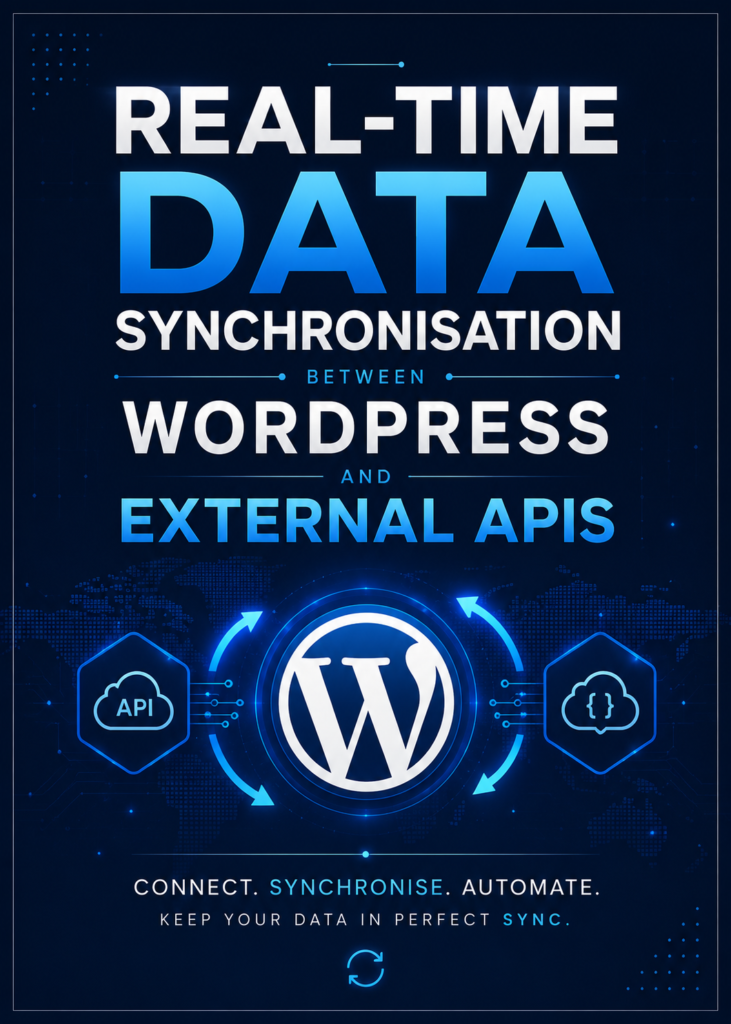
This article explores the architecture, technologies, implementation strategies, security considerations, and best practices involved in building reliable real-time data synchronisation between WordPress and external APIs.
Understanding Real-Time Data Synchronisation
Real-time data synchronisation refers to the continuous exchange of information between two or more independent systems immediately after a change occurs.
Instead of storing isolated copies of information, connected platforms remain synchronised by transmitting updates as events happen.
For example:
- A WooCommerce order is automatically sent to a CRM.
- A booking created in an external PMS instantly appears on a WordPress website.
- Customer profile updates are reflected across all connected applications.
- Inventory changes update product availability within seconds.
- Payment confirmations trigger automatic order processing.
The objective is simple:
One action. One source of truth. Multiple systems updated automatically.
Why Real-Time Synchronisation Matters
Businesses increasingly depend on interconnected software ecosystems. Delayed or inconsistent information can lead to operational inefficiencies and poor customer experiences.
Real-time synchronisation helps organisations by:
- Eliminating duplicate data entry
- Reducing human errors
- Improving operational efficiency
- Delivering consistent customer experiences
- Supporting business automation
- Providing accurate reporting
- Enhancing scalability
- Accelerating business workflows
For organisations processing thousands of daily transactions, even small delays can create significant inconsistencies across systems.
Common WordPress Integration Scenarios
Real-time synchronisation is used across numerous industries.
WooCommerce Integrations
Typical synchronisation includes:
- Orders
- Customers
- Products
- Inventory
- Shipping updates
- Payment confirmations
- Refund status
CRM Synchronisation
WordPress frequently exchanges data with CRM platforms to maintain customer records.
Examples include:
- Lead generation
- Contact management
- Customer segmentation
- Marketing automation
- Sales pipeline updates
Property Management Systems
Hospitality businesses often synchronise:
- Property availability
- Booking calendars
- Pricing
- Guest information
- Reservation status
This prevents double bookings while ensuring accurate listings.
Learning Management Systems
Educational platforms synchronise:
- Student registrations
- Course enrolments
- Progress tracking
- Certificates
- User permissions
Membership Platforms
Subscription websites commonly synchronise:
- User roles
- Membership status
- Payment history
- Subscription renewals
- Access permissions
Architecture of a Real-Time Synchronisation System
A reliable synchronisation solution typically consists of several interconnected components.
User Action
↓
WordPress Event
↓
Validation Layer
↓
API Request
↓
Authentication
↓
External System
↓
Response Handling
↓
Database Update
↓
Logging & Monitoring
Each stage plays a critical role in ensuring data integrity and system reliability.
Methods of Real-Time Synchronisation
Several architectural approaches can be used depending on business requirements.
1. Webhooks
Webhooks are among the most efficient methods for real-time communication.
Instead of repeatedly checking for updates, the external system immediately sends a notification whenever an event occurs.
Examples include:
- New orders
- Payment completion
- Booking confirmations
- Customer registration
- Product updates
Advantages
- Instant updates
- Low server load
- Highly scalable
- Event-driven architecture
2. REST APIs
REST APIs enable secure communication between WordPress and external platforms using HTTP requests.
Common operations include:
- GET
- POST
- PUT
- PATCH
- DELETE
REST APIs provide flexibility for reading, creating, updating, and deleting data across connected systems.
3. Polling
Polling periodically checks an external API for changes.
Although simple to implement, it may introduce delays and unnecessary server requests.
Polling is suitable when webhooks are unavailable.
4. Message Queues
Large-scale systems often introduce queues to process synchronisation tasks asynchronously.
Popular message brokers include:
- RabbitMQ
- Apache Kafka
- Amazon SQS
- Redis Queues
Queues improve scalability while preventing request bottlenecks.
Authentication Strategies
Security is fundamental when synchronising sensitive business information.
Common authentication mechanisms include:
API Keys
Simple and widely supported for server-to-server communication.
OAuth 2.0
Ideal for applications requiring delegated user access without exposing credentials.
JWT Authentication
JSON Web Tokens enable secure identity verification between applications.
Bearer Tokens
Frequently used alongside OAuth to authorise authenticated requests.
Data Validation Before Synchronisation
Never assume incoming data is valid.
Every request should undergo validation before processing.
Recommended checks include:
- Required fields
- Data types
- Email validation
- Date formatting
- Duplicate detection
- Business rules
- Input sanitisation
- Output escaping
Strong validation prevents corrupted records from entering production systems.
Error Handling Strategies
Network interruptions and API failures are inevitable.
Robust systems should anticipate failures rather than simply react to them.
Recommended techniques include:
- Retry failed requests
- Exponential backoff
- Request timeouts
- Detailed error logging
- Dead-letter queues
- Alert notifications
- Transaction rollback where appropriate
Effective error handling greatly improves system reliability.
Managing Data Conflicts
Conflicts occur when the same information is modified simultaneously in multiple systems.
Common conflict resolution strategies include:
- Last-write wins
- Timestamp comparison
- Version control
- Manual approval workflows
- Source-of-truth prioritisation
Selecting an appropriate strategy depends on business requirements and data sensitivity.
Performance Optimisation Techniques
As synchronisation frequency increases, performance becomes increasingly important.
Optimisation techniques include:
- Batch processing
- Database indexing
- Object caching
- Lazy loading
- Asynchronous requests
- Background processing
- Efficient SQL queries
- Pagination for large datasets
These practices reduce server load while improving response times.
Caching Considerations
Caching improves performance but requires careful implementation.
Frequently cached resources include:
- Product catalogues
- API responses
- Configuration settings
- Exchange rates
- Tax information
Cache invalidation policies should ensure outdated information is removed promptly after updates.
Security Best Practices
Protecting synchronised data requires multiple layers of security.
Recommended practices include:
- HTTPS encryption
- Secure API authentication
- Rate limiting
- Nonce verification
- Input sanitisation
- Output escaping
- Web Application Firewalls
- Principle of least privilege
- API request logging
- Secret management using environment variables
Security should never be treated as an afterthought.
Monitoring and Observability
Visibility into synchronisation processes is essential for diagnosing issues before they affect users.
Important metrics include:
- API response times
- Failed synchronisations
- Queue length
- Success rates
- Error frequency
- Retry counts
- Processing duration
Comprehensive monitoring enables proactive maintenance and faster incident resolution.
Practical Business Applications
Real-time synchronisation delivers measurable value across industries.
E-Commerce
- Product inventory
- Orders
- Shipping
- Customer accounts
- Discounts
Healthcare
- Appointment scheduling
- Patient records
- Billing updates
Hospitality
- Room availability
- Dynamic pricing
- Reservations
- Guest management
Education
- Student enrolments
- Attendance
- Certificates
- Course progress
Finance
- Payment confirmations
- Invoice generation
- Transaction reconciliation
Marketing
- Lead capture
- Campaign automation
- Customer segmentation
- Analytics synchronisation
Common Mistakes Developers Should Avoid
Even experienced developers encounter integration challenges.
Some of the most common mistakes include:
- Ignoring API rate limits
- Hardcoding credentials
- Poor error handling
- Blocking synchronous requests
- Missing input validation
- Inadequate logging
- Overusing polling instead of webhooks
- Failing to document API contracts
- Not planning for scalability
Avoiding these pitfalls leads to more maintainable and dependable integrations.
The Future of WordPress Integrations
As businesses embrace cloud-native architectures and AI-driven workflows, real-time integrations will become even more sophisticated.
Emerging trends include:
- Event-driven architectures
- Serverless integration platforms
- AI-assisted data mapping
- Edge computing
- GraphQL APIs
- Low-code automation
- Intelligent workflow orchestration
- Real-time analytics pipelines
Developers who master these technologies will be well positioned to build the next generation of connected digital experiences.
Conclusion
Real-time data synchronisation has become a fundamental requirement for modern WordPress applications. Whether connecting e-commerce platforms, CRM systems, booking engines, learning platforms, or enterprise software, reliable synchronisation ensures that every connected system operates using accurate and consistent information.
Building successful integrations requires more than simply sending API requests. Developers must carefully design architectures that prioritise security, scalability, resilience, validation, monitoring, and performance. By combining event-driven workflows, robust authentication, comprehensive error handling, and efficient data processing, WordPress can serve as a powerful integration hub within complex digital ecosystems.
As organisations continue to adopt interconnected technologies, real-time synchronisation will remain a critical capability for delivering seamless user experiences, streamlining business operations, and enabling intelligent automation. Investing in well-designed integration strategies today lays the foundation for more agile, scalable, and future-ready WordPress solutions tomorrow.